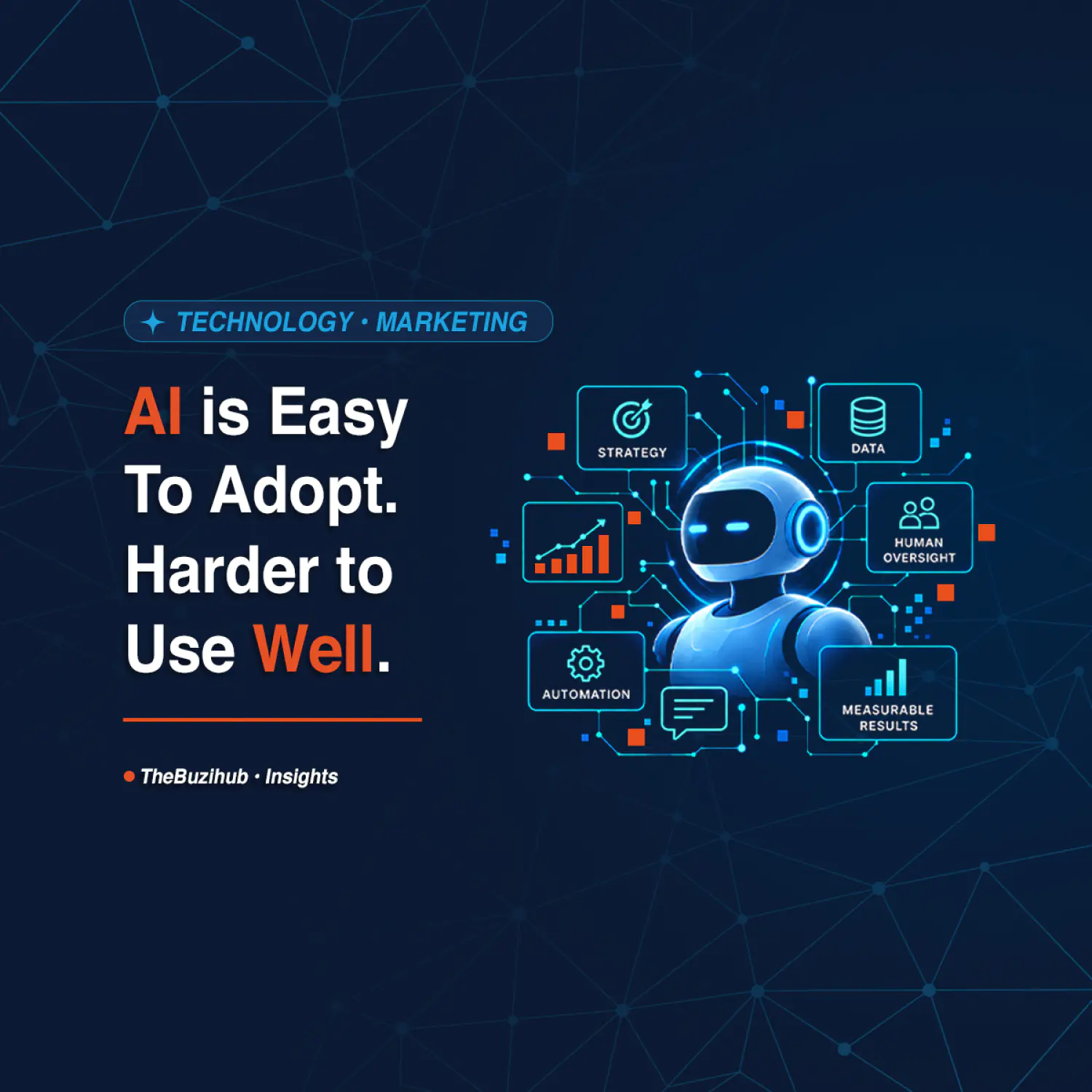
AI Is Easy to Adopt. Harder to Use Well.
AI is changing how businesses work, but adding more tools does not automatically create better results. The real opportunity lies in knowing where AI can solve real business problems, improve processes, and support better decisions.A clear AI strategy starts with the right questions, the right data, and a practical approach to implementation.
Having AI Tools Is Not the Same as Having an AI Strategy
Adding another AI tool to a technology stack is easy. Knowing why you need it is harder.
AI can generate content in seconds, summarize reports, analyze campaign performance, and automate repetitive work. But without a clear objective, businesses can quickly end up with more tools, more output, and very little improvement.
A better starting point is a simple question: What are we actually trying to improve?
Maybe a marketing team is spending too much time preparing content. Maybe sales teams are receiving a high volume of leads but too few qualified opportunities. Maybe customer data exists across several platforms, making it difficult to understand what is actually driving conversions.
These are business problems. AI simply becomes one of the tools used to solve them. That distinction matters because technology should support the strategy, not define it.
Automate What Matters
Automation sounds attractive because everyone wants to save time. But saving time on the wrong process does not necessarily create value.
If a business has a weak lead-generation process, automating it will simply produce more weak leads, faster. If its content strategy is unclear, producing content at twice the speed will not automatically make the content more effective.
The question should therefore be less about "What can we automate? and more about
What is worth automating?
A useful process usually has four characteristics:
- It happens repeatedly.
- It takes meaningful time.
- Its outcome can be measured.
- Technology can improve the result.
When those conditions exist, automation can remove unnecessary manual work and give teams more time for the parts of marketing that require creativity, judgment, and strategic thinking.
The goal is not more activity. It is better efficiency.
AI Needs Good Data
This is where many AI conversations become less exciting — and much more important.
AI can process enormous amounts of information. But it still needs good information to work with.
For many businesses, marketing data is spread across Meta Ads, Google Ads, CRM systems, websites, WhatsApp, email platforms, and analytics tools. Each platform may contain a piece of the customer journey. The problem is what happens when those pieces do not connect.
A company may know that someone clicked an advertisement. It may know that the same person submitted a form. It may even know that a sale happened later. But can it connect those actions?
- Can it understand which marketing activity contributed to the final result?
- Can it see where potential customers are dropping out of the journey?
Before adding another AI solution, businesses should look at the foundation underneath it:
- Is the data accurate?
- Is it accessible?
- Are the systems connected?
- Can performance be tracked from one stage to the next?
AI can process information quickly. It cannot make disconnected or unreliable data magically become useful.
The Human Layer Still Matters
AI can generate, analyze, predict, and automate. But marketing still requires context.
Give an AI tool a campaign brief and it can produce twenty ideas in seconds. That does not mean all twenty ideas are right for the brand. Someone still needs to understand the audience. Someone needs to understand the market. Someone needs to know what the brand should sound like — and what it should never sound like.
The same applies to performance. AI can identify that a campaign suddenly performed worse than expected. But understanding why requires context.
- Was there a change in the offer?
- Did the audience change?
- Did competitors launch something new?
- Did something happen in the market?
The technology can help identify the signal. People still need to understand it.
AI brings speed and scale. Strategy provides direction.
The strongest marketing systems are not built around choosing between humans and technology. They use technology to give people better information, faster processes, and more room to focus on decisions that actually matter.
Start With One Problem
AI adoption does not need to begin with a complete digital transformation. In fact, starting with everything at once can make it harder to understand what is actually working.
A better approach can be much simpler. Start with one problem.
Find a process that is repetitive, time-consuming, and measurable. Apply AI where it can add value. Measure the impact. Then scale what works.
Imagine a marketing team spending ten hours every week preparing campaign reports. An AI-supported workflow could help collect the information, summarize important changes, and highlight unusual patterns. The team could then spend less time preparing the report and more time asking the questions that matter:
- What changed?
- Why did it change?
- What should we do next?
And the impact can be measured:
- How much time was saved?
- Did reporting become more consistent?
- Did decisions happen faster?
- Did the quality of analysis improve?
If the answer is yes, the process can be expanded.
Start small. Measure. Optimize. Scale.
What Good AI Adoption Looks Like
Good AI adoption is not about having the largest number of AI tools. It is about creating a system where technology has a clear role.
That means:
- Clear business objectives
- Relevant AI use cases
- Reliable data
- Connected systems
- Human oversight
- Measurable outcomes
- Continuous optimization
There is a big difference between saying:
We want to use AI for social media.
And defining a clear business outcome such as:
We want to reduce content production time by 40% while maintaining brand consistency and improving performance.
The first approach is about technology. The second is about business outcomes.
That is the shift businesses need to make as AI becomes a bigger part of marketing. The question is no longer simply "Are we using AI?" It is: Is AI actually improving the way we work?
The Bottom Line
AI can generate. AI can analyze. AI can automate. But strategy determines what matters, why it matters, and what should happen next.
For marketing teams, the opportunity is not simply to produce more, automate more, or adopt more technology. It is to build smarter processes that connect technology, data, creativity, and human decision-making to measurable business value.
Because adopting AI is easy. Using it well is the real work.
At TheBuzihub, we help businesses turn strategy, technology, creativity, and data into growth systems built to perform.



BuziBlog
Subscribe to BuziBlog
New articles on marketing, technology and business, straight to your inbox.
We are committed to your privacy. TheBuzihub uses the information you provide to send you BuziBlog articles. You can unsubscribe from any email we send.