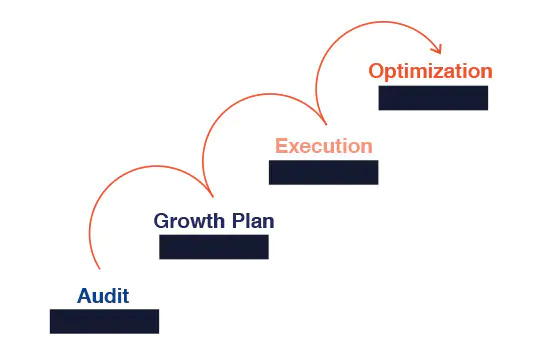
Strategy & Execution Growth Programs
End-to-end growth programs built around business outcomes
Build acquisition systems that attract the right audience
Align SEO, performance marketing, and conversion
Reduce uncertainty in growth decisions
Create clarity that executives can act on
Core Support Services
Our In-house services backing and powering the strategy, revenue system, and growth architecture we design.
Supporting Services
Designed to reinforce and sustain the growth system

Digital Product Management & Automation
We streamline digital product development, ensuring companies save time and access specialized expertise for efficient implementation. This also includes Products Set up and automation such as CRMs and bots.
Learn more
Social Media Marketing & Advertising
Engage, inspire, and convert with impactful social media strategies. We create targeted campaigns, compelling content, and data-backed ads that connect with your audience, strengthen your brand presence, and drive measurable results across all major platforms.
Learn more
Branding & Graphic Design
You’re not just a brand, you’re a statement! From logos to social media posts, we bring your vision to life with designs that make an impact.
Learn more
OOH & Offline Marketing
Product displays, networking and interview setups, production setups, live test drives, and out-of-home advertising (billboards, digital screens, lamp posts, etc.)
Learn more
Launch Your
Website. Pay Monthly.
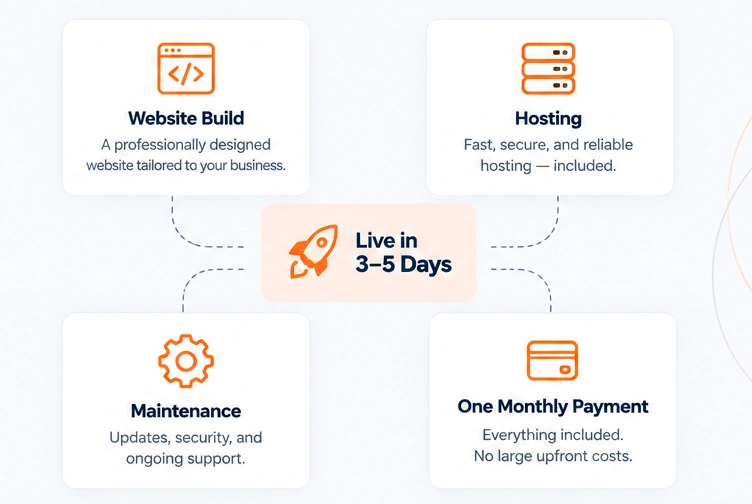
Why pay a large amount upfront for a website? Our Website Subscription gives you a professionally built, hosted, and maintained website for one simple monthly payment.
From development to hosting and maintenance, we take care of the technical side, so you can focus on running your business.
Stop losing leads. Let your business follow up, book and sell on autopilot.
One CRM for every lead, chat, booking and deal, with automations that reply in seconds and follow up for days. We set everything up for you, so your team only does the closing.
- WhatsApp, Instagram, email and website chats in one inbox
- AI assistant that answers and qualifies leads 24/7
- Follow-ups, reminders and quote chasing that run themselves
- A clear view of which ad and channel brings real revenue
Message us on WhatsApp. We'll walk you through it and set up your account.
Unified inbox
Every conversation from every channel, with the full history of each contact.
Sales pipelines
See every deal by stage and value, and know exactly what's coming in.
Bookings & reminders
Clients book themselves, get reminded on WhatsApp and email, and rebook if they miss.
Quotes & payments
Send quotes, get them e-signed and collect payment, all inside the CRM.
- New lead from ad or form
- Instant WhatsApp reply
- Team alert + call task
- Follow-ups until booked

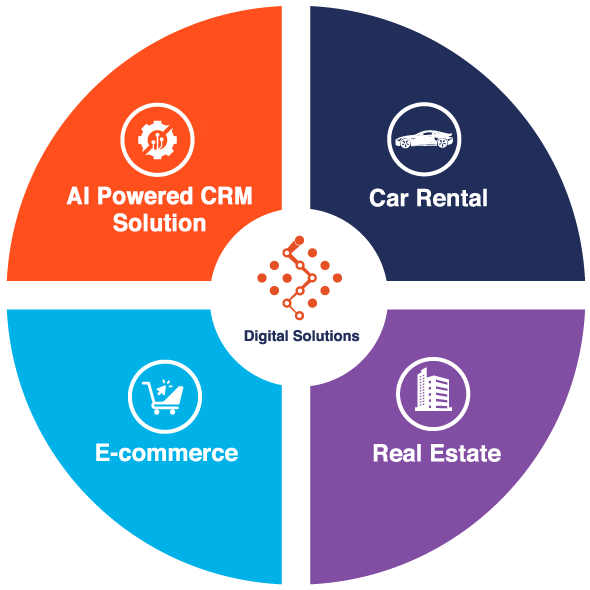
Industries We Serve

REAL ESTATE

INTERIOR DESIGN

JEWELRY

CAR RENTAL

FASHION E-COMMERCE

MALLS & RETAIL

FLOWERS

HEALTHCARE
Some of our Work
Built to perform. Designed to convert. A snapshot of how we help brands grow.
See All
Drive Ease Car Rental Website & System
Drive Ease Car Rental is a UAE-based vehicle leasing company offering both short-term and long-term options for residents and visitors. The business focuses on delivering a smooth customer experience through an online booking platform, while maintaining strong internal operational control across fleet management, reservations, and financial tracking.


Lama Jewelry Website & System
Lama Jewelry is a luxury jewelry brand offering handcrafted gold and precious metal pieces. The brand combines traditional craftsmanship with modern e-commerce, allowing customers to browse, customize, and purchase jewelry online while ensuring pricing accuracy based on real-time precious metal values.

Fair Trading International - SEO
FT International (FTI) is a UAE-based wholesale trading company specializing in branded stocklots, surplus inventory, and wholesale apparel distribution, operating primarily across Dubai, Jebel Ali Freezone, and the wider Middle East market. SEO plays a critical role in capturing high-intent B2B wholesale searches and converting organic demand into qualified trade inquiries.

Gaming - Ads
The client is one of the leading online gaming businesses operating in a highly competitive and performance-driven market. Their success depends on their ability to acquire large volumes of qualified users while maintaining profitability under strict CPA targets.

Crypto Ads Case Study
The client operates a crypto-focused media channel designed to deliver cryptocurrency news, market updates, and industry insights to an engaged audience. The business model depends on building a large, high-quality subscriber base that can be monetized through partnerships, advertising, and affiliate offers.

Creative Closets - UAE/OMN/BAH - SEO
Creative Closets is a premium custom storage and interiors brand specializing in bespoke closets, wardrobes, and space-saving solutions for residential and commercial clients across the GCC. The company combines high-end design, precision engineering, and quality materials to deliver tailored solutions that elevate both lifestyle and functionality.

Creative Closets - KSA - SEO
Creative Closets is a leading custom storage and wardrobe solutions company founded in Saudi Arabia in 1997, credited with introducing and defining the custom closet concept in the Middle East.

Closets World - KSA - SEO
Closets World (عالم الخزائن) is a Saudi Arabian custom closet and storage solutions company that specializes in designing, manufacturing, and installing tailored closet systems and built‑in storage for residential interiors. Since its inception in 2005, the company has become known for offering practical, stylish, and customized wardrobe and storage solutions that reflect both customer needs and lifestyle preferences.

Closet World - UAE/OMN - SEO
Closet World is a well-rated custom closet and storage solutions company based in the United Arab Emirates, with showrooms in Dubai and Sharjah. It specializes in bespoke closet systems and tailored interior storage designs that elevate both functionality and style in residential homes.

Closets World KSA - Ads
A premium home interiors brand specializing in custom closets and modern kitchens, transforming storage spaces into artistic design elements. By combining advanced technology, high-quality materials, luxury designs, and precision craftsmanship, the brand delivers bespoke solutions aligned with international quality standards for the Saudi market.

Creative Closets UAE/OMN/BAH - Ads
Creative Closet pioneered smart home storage systems in the Middle East. Over the past 25 years, the brand has expanded from smart closets into bespoke bedroom solutions, serving more than 120,000 users across the UAE, Bahrain, and Oman.

Closet World UAE/OMN - Ads
Closet World is a luxury home storage brand redefining closets as design centerpieces rather than simple storage spaces. Operating primarily in Dubai, Sharjah and Muscat, the brand combines advanced technology, premium materials, and meticulous craftsmanship to deliver bespoke closet and storage solutions. With a philosophy of “Luxury for All,” Closet World serves a wide range of customers while maintaining high design and quality standards.
ADVANCED INNOVATIONS FOR OPTIMAL PERFORMANCE
Top-Quality Ready Solutions
What our clients say
We’re proud to be trusted by clients who value clear communication, fast delivery, and reliable results. Here’s what they say about working with us.
Who TheBuzihub is, and who it works with
TheBuzihub is a growth agency based in Dubai, delivering revenue systems for businesses across the six GCC markets rather than for any single industry or company size.
The seven services — SEO, advertising, social media, technology, branding, reputation management, and growth programs — are all delivered in-house.
The businesses that fit best already have a working product or service and enough traction to know growth is fragmented rather than absent: marketing efforts exist but do not reinforce each other, a website generates traffic that does not convert, or a brand looks different across every channel it touches.
The approach starts with a full audit of what already exists — the website, current campaigns, the brand, the tech stack — before recommending anything, since the right starting service depends entirely on where the actual bottleneck sits, not on a default package.
Execution runs entirely in-house across the seven services rather than being subcontracted out, which is what keeps a growth roadmap and the team actually building it in the same room.
The result the model is built around is not a single campaign win but a system: channels that compound together over months rather than a spike that fades once one campaign ends.
Who this is for
The client base spans retail and interiors, wholesale and B2B trading, real estate and property services, hospitality and F&B, and a handful of digital-native businesses in gaming and media — different industries, but a similar shape of problem each time: an established operation with real revenue, where marketing has grown in pieces rather than as one system.
That "already established" starting point matters more than the industry itself. A brand-new business still validating whether its product has demand is usually better served starting with one focused service and proving that channel works, rather than a multi-service program built to coordinate channels that do not exist yet.
The fit gets clearer once a business can point to a specific symptom — traffic that does not convert, a brand that looks inconsistent across platforms, a website that cannot support the marketing running on top of it — rather than a general sense that "marketing should be doing more." Business size varies more than industry does across the client base — some are single-location operations with a handful of staff, others run multiple showrooms or a multi-market distribution operation, and the growth model scales to both rather than assuming a specific company size.
What stays constant regardless of size is the starting posture: an audit before a recommendation, not a recommendation before anyone has actually looked at what the business already has in place.
A business that skips that step and buys a service based on what worked for someone else's company often finds the service does not address its actual constraint, since the constraint was never diagnosed in the first place.
Selectivity runs in both directions, and it is worth saying plainly: not every business that reaches out is taken on.
A program built around coordinating several channels only works when there is enough scope and budget to actually run that coordination — a very small engagement forced into a multi-service structure ends up under-resourced on every channel rather than well-served on one, which helps nobody.
Being told a single focused service is the better starting point, even when a bigger program was the original ask, is a normal outcome of the audit, not a downsell.
Why channel coordination compounds
Channels that run in isolation quietly work against each other, even when each one individually looks fine. SEO content built without the brand and paid teams in the same room tends to target keywords that do not match what the ad creative is already promising, so a visitor lands on a page that feels like a different pitch than the ad that brought them there.
A paid campaign run without technology input often drives traffic to a site that was never built to convert it, which shows up as a rising ad spend with a flat conversion rate nobody on the marketing side can actually fix, since the constraint sits on the technical side.
Coordinating channels means those dependencies are mapped before work starts, not discovered mid-campaign when a channel underperforms for a reason that turns out to sit one team over.
It is also why the services are delivered in-house rather than farmed out: a dependency between two channels is much harder to catch when the two teams working on them do not talk to each other.
The cost of the alternative — channels running in isolation — is usually invisible until someone goes looking for it specifically, because each individual channel can still report a plausible number on its own.
A paid campaign shows a reasonable cost-per-click, an SEO program shows rankings moving, and a social account shows growing engagement, and none of those numbers individually reveals that the traffic each channel drives is landing on a site that converts poorly, or that the brand each channel represents looks inconsistent enough to quietly erode trust before a purchase happens.
Reviewing the system as a whole is what surfaces that gap, rather than each channel's own report in isolation — a different question than whether any single channel is "working." Reporting reflects that same coordination: a client sees channel-level detail — what SEO specifically did that month, what a given ad set spent and returned — alongside a blended view of how the system as a whole moved, rather than one number standing in for everything or seven disconnected reports with no shared summary.
That combination is what makes it possible to tell the difference between a channel that is genuinely underperforming and a channel that is doing its job correctly while a dependency elsewhere is capping the result — a distinction a single-channel report, read on its own, usually cannot make.
Markets and languages this covers
Six GCC markets means six different search, social, and regulatory environments, not one region treated as a single audience. E-commerce and app work built for the UAE needs to account for payment methods and delivery logistics that do not carry over identically to Saudi Arabia, and a growth program coordinating several channels across two or three of those markets at once is a different scoping exercise than running the same program in a single city.
Language runs alongside market rather than following it automatically: a bilingual audience in Dubai and a largely Arabic-first audience in a smaller Gulf market are not served by the same content translated once, which is why English and Arabic are planned as two native executions rather than one adapted from the other.
None of the seven services runs identically from market to market, and part of the initial audit is establishing which specific version of each service a client's actual footprint needs.
Regulatory and payment context shifts by market too, in ways that change how a campaign or a checkout flow actually gets built rather than just how it reads.
Payment preferences differ enough between markets that a checkout flow built around one country's habits underperforms in the next; advertising rules and platform availability also differ enough between markets that a campaign structure approved and performing in one country cannot always be copied directly into another without review.
None of this is exotic — it is closer to a standard checklist by now — but it is exactly the kind of detail that a single regional template misses, and part of why market-by-market planning is built into the process rather than treated as a later adjustment.
Time zone and working-hours overlap sound minor next to strategy and budget, but they show up constantly in how smoothly an engagement actually runs — a Dubai-based team working GCC business hours means campaign approvals, urgent fixes, and reporting calls land inside the same working day for most clients in the region, rather than queued behind a multi-hour offset that a remote or overseas agency often carries.
It is a small operational detail that compounds the same way the larger channel dependencies do: unnoticed until it becomes friction, and rarely mentioned until a client has already worked with an agency where it was not true.
Frequently asked questions
What kind of business do you work with?
Established businesses with real revenue and a working product, where marketing has grown in pieces rather than as one system — a website that does not convert, a brand that looks different across channels, or campaigns that do not reinforce each other. A brand-new business still validating demand is usually better served starting with one focused service elsewhere first.
Which markets do you actually cover?
The team is based in Dubai and works across the wider GCC, with the specific service mix adapting to each market's search behavior, platform preferences, and language needs rather than one regional default applied everywhere. A business expanding from one market into a second gets that mix reassessed, not simply copied across the border.
How do we start working together?
With a full audit of what already exists — the website, current campaigns, the brand, the tech stack — before anything is recommended, since the right starting point depends on where the actual bottleneck sits. That audit turns into a scoped proposal, not a generic package pitch.
What makes this different from hiring a single-channel agency?
Coordination between channels rather than each one optimizing in isolation — the same team scoping the SEO strategy also knows what the paid campaigns are promising and what the website can actually support, which catches dependencies a single-channel agency working alone would not see until a campaign was already underperforming.
How long before we see results?
It depends on the channel — paid traffic can move within days, while SEO and brand-building compound over months. A bundled program reports on both the fast-moving and slow-building pieces together, so a client can see near-term movement alongside the longer trend rather than waiting for one blended number.
Is there a minimum commitment?
It depends on scope — a narrowly focused single service can start smaller, while a multi-channel growth program typically asks for a longer minimum, since the coordination between channels is most of what it delivers and that takes months to show clearly.
Do you work with businesses outside the six core GCC markets?
Occasionally, on a project basis, though the core focus and the in-market expertise is built around the six GCC markets specifically. A business expanding into the region from elsewhere is a common starting point even when its home market sits outside that footprint.
How is everything priced?
Against actual scope — which services, which markets, how many channels — rather than one flat number for every client. A scoping call following the initial audit is what turns that into a specific figure, since two businesses asking for "the same service" often need meaningfully different amounts of work.
How big is the team actually working on our account?
It scales with scope — a single-service retainer gets a small dedicated group covering that channel, while a multi-service growth program brings specialists from each relevant discipline onto one coordinated team, led by a single account manager rather than a client managing several separate contacts.
What happens if our needs change significantly partway through?
The roadmap is revisited, not locked to the original scope — a business that started with SEO and later needs advertising added, or one that scales into a second market, gets the engagement rescoped around the new reality rather than treated as a separate contract negotiation from scratch.