Updated for 2026
Search engine optimisation is the practice of earning positions in search results that you do not pay per click for. It has three working parts: a site machines can crawl and understand, pages that answer questions people are actually asking, and enough external evidence of credibility that search engines rank your answer above someone else's. In the Gulf it has a fourth, because the same business is usually being searched for in two languages and its Arabic pages are the ones most often left half-built.
TheBuzihub runs organic search programmes across six GCC markets — the UAE, Saudi Arabia, Qatar, Kuwait, Bahrain and Oman — in English and Arabic, from technical repair through to the writing that earns the position.
This page is the regional programme in full. If you want the engagement scoped and costed instead, that is the SEO service line and what a retainer covers.
Claim your free SEO audit — tell us the domain and we will send back what is actually holding it down. Or call +971 54 545 3510.
What changed: ranking is no longer the only outcome worth having
For twenty years the object of SEO was a position on a page of ten blue links. That page is now frequently a written answer with a handful of citations underneath it, and the citation is the click.
Google's AI Overviews, ChatGPT's browsing mode, Perplexity and Bing Copilot all resolve a question by reading sources and summarising them. They quote pages that state things plainly, in extractable blocks, with the claim near the top. A page that buries its answer under three paragraphs of positioning is not outranked — it is simply not read.
This does not replace conventional SEO. Every one of those systems still has to find, crawl and trust the page first, which is the same technical and authority work as before. What it changes is the writing: the same facts, stated in a form a machine can lift whole.
We treat that as one requirement rather than two disciplines. The deeper treatment of how the answer engines pick sources lives on what AI Overviews changed about ranking in the Gulf, and the implementation sequence on the GEO playbook.
The four parts of a Gulf SEO programme
Technical: whether the site can be read at all
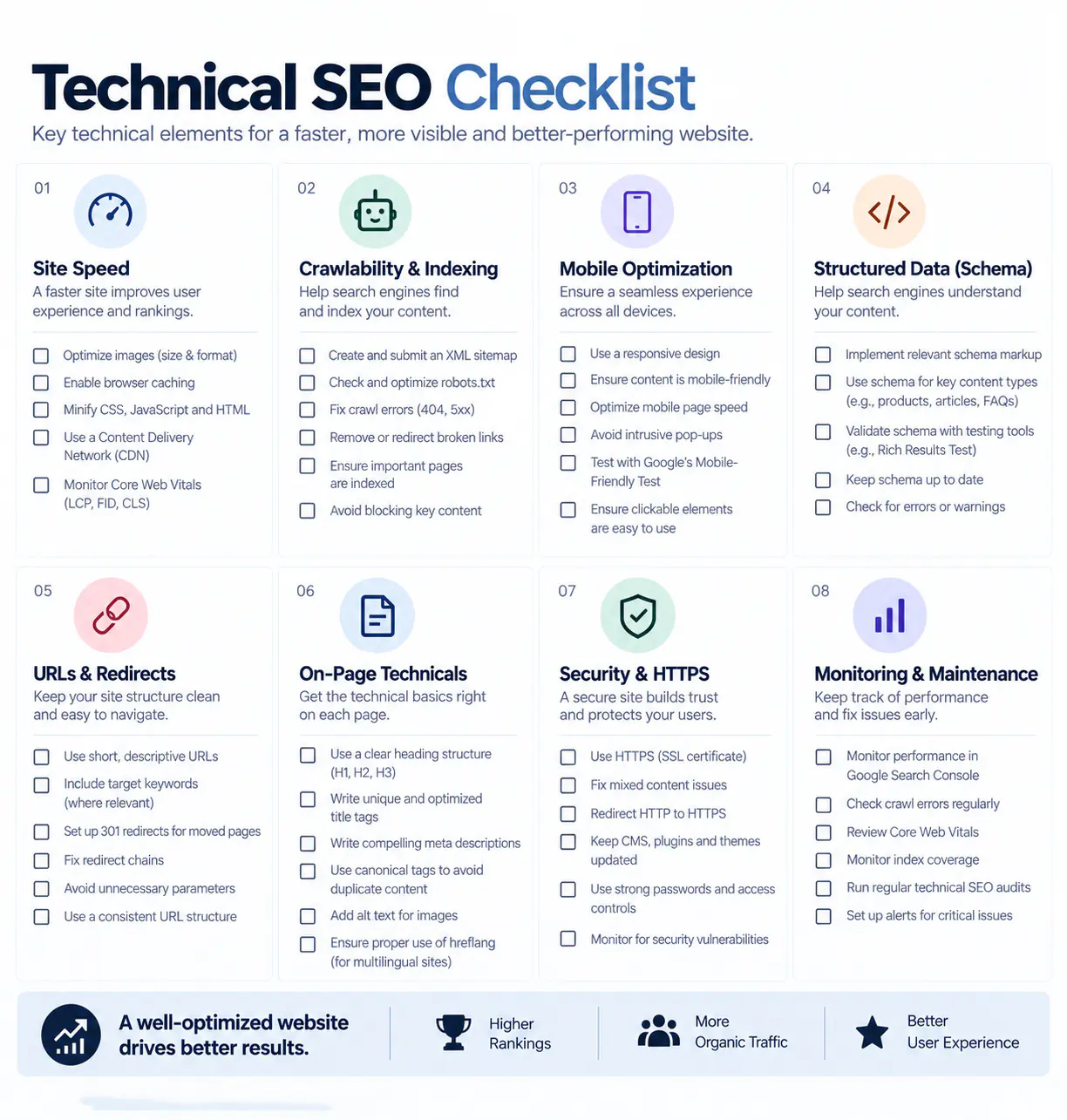
Crawlability and indexation come first because nothing downstream matters without them. We work through server response codes, redirect chains, canonical conflicts, pagination, JavaScript rendering, sitemap accuracy and the crawl budget a large catalogue quietly consumes.
Two failures are specific enough to the region to call out. The first is hreflang: a bilingual site needs reciprocal annotations between its English and Arabic pages, and a self-referential canonical on each. Get one direction wrong and Google treats the pair as duplicates and picks one — usually the English.
The second is regional targeting. A single site serving all six markets is competing on six different result sets, and the signals that separate them are structural, not textual.
Index bloat is the third thing we find on nearly every large site and almost nobody reports. Filtered category views, session parameters, print variants and expired listings accumulate into large numbers of indexable near-duplicates, and every one of them spends crawl attention your commercial pages needed. The fix is rarely to add anything; it is to decide, page type by page type, what should be crawled, what should be indexed, and what should be neither.
Structured data belongs in this layer rather than in a content checklist. Marking up an organisation, its services, its location and a page's questions is how a search engine resolves which business a page is about — and a graph that names the same company twice under two slightly different identities is worse than no markup, because it splits the entity instead of confirming it.
Where the site itself is the constraint rather than its content, that becomes a build conversation — see the decisions made at build time that set your crawl budget.
Bilingual: Arabic as a first language, not a translation
Arabic SEO fails most often for a reason that has nothing to do with search: the Arabic pages were translated from the English after the fact.
Translated pages target the phrases an English speaker would use, rendered into Arabic. Real Arabic search behaviour uses different words, different question forms, and a mixture of Modern Standard Arabic and dialect that varies between Riyadh and Dubai. Keyword research has to be done natively in Arabic or it describes a market nobody is searching in.
The technical half matters too — right-to-left layout, correct lang and dir attributes, Arabic-aware URL handling, and typography that does not letter-space or fake the script.
We research and write Arabic natively, then align it to the English structurally rather than word for word. Market-level detail belongs to the location pages: Arabic-first ranking in the Saudi market and the Dubai SERP and its licensing context.
Content: the page that deserves the position
Ranking follows from being the most useful answer, so the work is editorial before it is technical. We map queries to the stage of the decision they belong to, identify what the currently-ranking pages fail to say, and build pages that own a scope no sibling page owns.
The failure we correct most often is a site that has published twenty pages about one topic and split its own authority across all of them, so none of them ranks. Consolidating is usually worth more than publishing.
Ongoing production is a separate discipline with its own rhythm — the editorial calendar that feeds organic.
Authority: the evidence outside your own site
Links and mentions remain the strongest external signal, and the least controllable. We work on the things that legitimately earn them: original data, genuinely useful reference pages, regional directory and association presence, digital PR, and the supplier and partner relationships a Gulf business already has.
We do not buy links. Beyond the policy risk, a bought profile is unusually easy for a competitor to report, and the recovery costs more than the position was worth.
Schedule your complimentary strategy session — book a time and we will walk through your current organic footprint on the call.
The five failures we are usually hired to fix
Most engagements start from one of a small number of situations, and naming them is more useful than describing an ideal state nobody starts from.
The site was rebuilt and traffic fell. Almost always redirects. A redesign that changes URL structure without a one-to-one map discards the accumulated authority of every page it moves, and the loss shows up two to six weeks later when the old URLs drop out of the index.
Everything ranks except the pages that sell. Informational content is easier to rank than commercial pages, so a blog can perform while the service pages do not. The usual cause is that the commercial pages have no internal links pointing at them from anything that ranks.
The Arabic site gets no traffic. Covered above: it was translated rather than researched, so it targets phrases nobody searches.
Twenty pages, one topic, no rankings. Self-cannibalisation. Consolidating into a smaller number of stronger pages, with redirects from the retired ones, typically recovers more than any amount of new publishing.
Rankings are fine but nothing converts. Not an SEO problem. The traffic is arriving on queries with the wrong intent, or the page ranks for a term whose searchers were never going to buy.
Each has a different first month. That is why the audit precedes the proposal rather than following it.
Our data-driven methodology
Every programme opens with forensic analysis rather than a proposal. We read the site the way a crawler does, then read the market the way a buyer does.
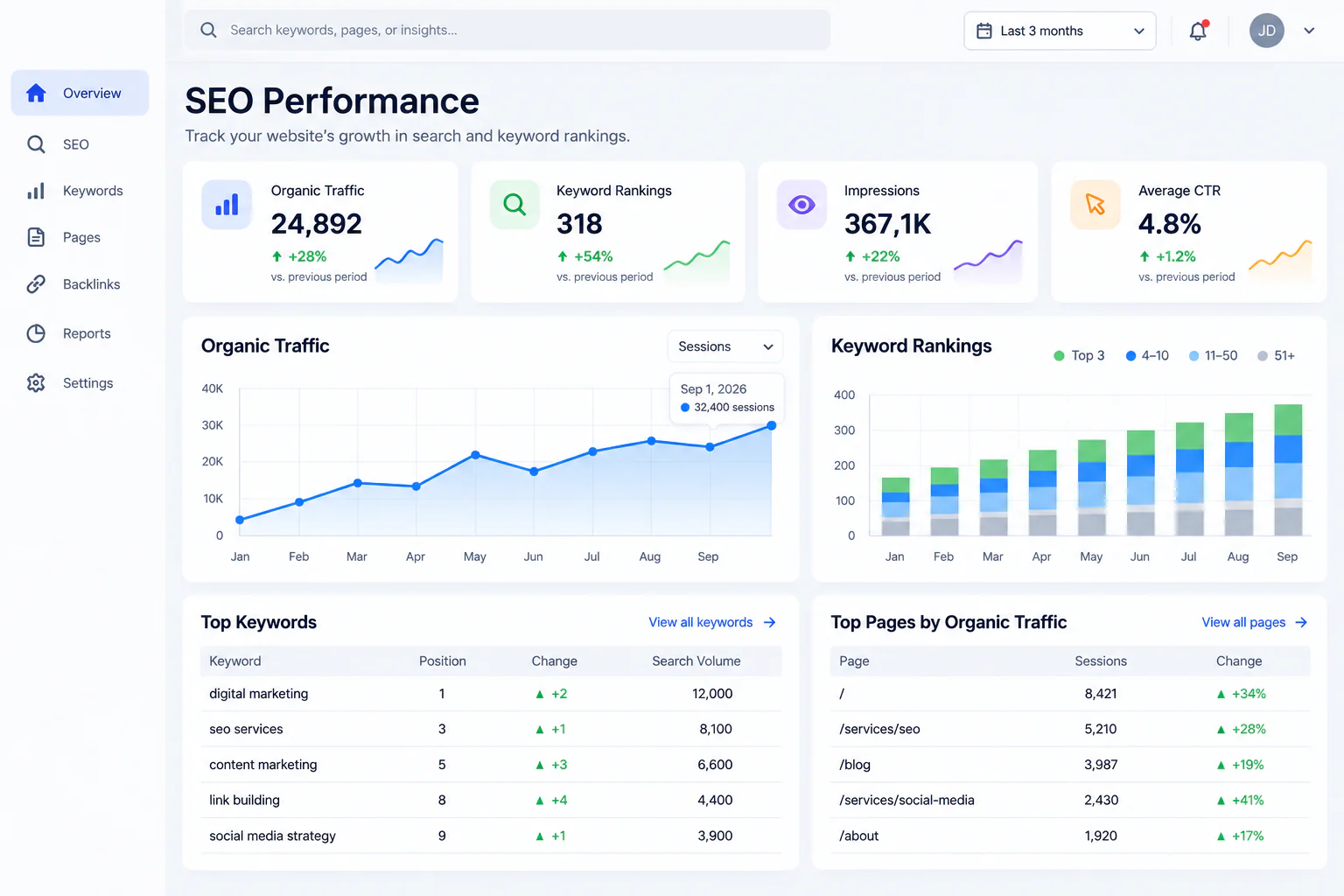
Baseline. What is indexed, what is not, and why. Which queries already produce impressions, at what average position, and where the drop-off between impression and click is largest — that gap is usually the cheapest win available.
Gap. What competitors rank for that you do not, separated into what you could plausibly win this quarter and what would take a year. The second list is not a target; it is a budget conversation.
Architecture. Queries mapped to pages, one primary intent per page, with the internal linking that tells search engines which page is the authority on what. This is where cannibalisation gets designed out rather than discovered later.
Repair, then build. Technical faults are fixed before new content is published, because publishing onto a broken foundation multiplies the fault.
Measure and revise. Monthly against the baseline, quarterly against the architecture.
We publish what we find at each stage, including the parts that are unflattering. A client who cannot see the reasoning cannot judge the work.
How organic performance is actually judged
Rankings move daily, vary by device and location, and are personalised, which makes a ranking screenshot the least reliable number in the report.
| Measure | What it tells you | What it does not |
|---|---|---|
| Impressions by query | whether you are entering the consideration set at all | whether anyone clicked |
| Click-through rate by position | whether your title and description earn the click you already qualified for | anything about page quality |
| Non-brand organic sessions | genuine discovery, separated from people who already knew you | which page did the work |
| Assisted conversions | organic's role early in a journey that closes on another channel | last-click revenue |
| Citations in AI answers | whether answer engines consider you a source | traffic, directly — many citations never produce a click |
| Indexed-to-published ratio | whether the site can be read | whether it deserves to rank |
Brand and non-brand traffic separated is the single most clarifying change most reporting needs. Channel-by-channel definitions are set out in which marketing numbers actually mean something.
Where organic is already delivering arrivals that do not convert, the constraint has moved downstream — that is turning arrivals into enquiries rather than an SEO problem.
What the published organic work shows
TheBuzihub has operated in the Gulf since 2018 and publishes 24 client case studies on this site — 17 in marketing and advertising, six in technology, one growth programme. Two are directly relevant here.
The Fair Trading International organic programme is a B2B trading business ranking in a competitive commercial category. The Creative Closets Saudi programme is the bilingual case — the same brand run separately for the Saudi and UAE markets, which is the structural problem described above, solved in practice.
Both are published in full, with the work described rather than summarised. If you want to interrogate an approach before hiring anyone, how to judge an SEO proposal sets out the questions worth asking — of us as much as anyone.
Organic Search FAQ
How long does SEO take to work in the GCC?
Technical fixes can move indexation within weeks. Competitive commercial rankings usually take six to twelve months, because authority accumulates rather than switching on. A useful early signal is impressions growing before positions do — that means the site is being read and evaluated, and it typically appears well before traffic changes.
Should our Arabic pages be translations of the English ones?
No. Translated pages target phrases rendered from English rather than the words people actually search in Arabic, and the two rarely match. Arabic keyword research done natively usually produces a different page structure, not just different wording. The pages should be structurally aligned and independently researched.
Do we need separate pages for each GCC country?
Only where the market genuinely differs — regulation, pricing, service availability or search behaviour. A separate page that repeats the same content with a city name swapped competes with its own siblings and dilutes all of them. One strong regional page beats six thin national ones.
How is SEO different from being cited by ChatGPT or AI Overviews?
The discovery work is the same: an answer engine still has to crawl and trust the page. The writing differs. Answer engines quote self-contained blocks that state a claim plainly, so the answer belongs near the top of the section rather than after the build-up.
Can you work on a site you did not build?
Yes, and most of our programmes are. What matters is access — the CMS, the DNS or hosting for technical changes, Search Console and analytics. Where a platform makes a required fix impossible, we say so early rather than working around it indefinitely.
What does an SEO programme cost?
It depends on the size of the site, the state of its technical foundation, how many languages and markets are in scope, and how much content production is included. We scope it after the audit rather than before. Regional budget ranges are set out on what digital marketing costs in this market.
Is a one-off audit enough, or do we need a retainer?
An audit is enough if you have a team who can implement it. If you do not, an audit produces a document rather than a result. The audit as a fixed-scope product is deliberately sold separately for exactly that reason.
What happens to our rankings if we stop?
They decay rather than collapse. Technical improvements persist, earned links persist, and existing content keeps ranking until something better replaces it — which in a competitive category takes months rather than weeks. What stops immediately is new coverage: no new queries entered, no response when a competitor publishes something stronger, and no correction when the site changes underneath you.
Related Reading at TheBuzihub
- Dubai's SERP and its licensing context — the same discipline at city level, where the competitive set is tightest.
- Vision 2030 procurement language and Arabic-dominant results — the Kingdom's search behaviour, treated on its own terms.
- A diagnosis with an end date — the audit bought as a deliverable rather than a retainer.
- What AI Overviews changed about ranking — why citation and position are now separate objectives.
- Spoken-query phrasing — how question form changes when nobody is typing.
- Product-catalogue architecture — faceted navigation, and the crawl budget it consumes.
- Paid coverage while organic compounds — the sequencing argument for running both.
- The build-vs-buy decision underneath all of it — platform constraints that decide what SEO can reach.
- A B2B trading brand's organic programme, written up in full — the work described rather than summarised.
The diagnosis comes first
Search work is unusually easy to evaluate before you commit to it, because the first deliverable is a diagnosis you can check.
Book a free discovery call and we will look at your domain before it. What you get back is what is indexed, what is not, which queries you are already close to winning, and what it would take — in effort, not adjectives.
Talk to us · How we work · The full service range
Phone: +971 54 545 3510 Email:info@thebuzihub.comOffice hours: Monday to Friday 09:00–18:00, Saturday 09:00–13:00 (UAE time). Current hours are always on the contact page.