Updated for 2026
Social media marketing is the work of choosing which platforms a business should be present on, producing enough of the right material to sustain that presence, and measuring whether any of it changed anything. Presence is the easy part; the choice and the measurement are where programmes succeed or quietly waste a year.
The decision is harder in the Gulf than in most regions, because platform behaviour varies sharply between six neighbouring markets and the audience in each is substantially expatriate, multilingual, and reachable in more than one language.
TheBuzihub plans and runs social programmes across the UAE, Saudi Arabia, Qatar, Kuwait, Bahrain and Oman. This page is the strategy and measurement layer; individual platforms have their own pages, and the social service line is where an engagement is scoped.
Book your strategy session — tell us who you are trying to reach and we will tell you which platforms are worth your time. Or call +971 54 545 3510.
Four situations, four different answers
The most common mistake in this discipline is running the same programme regardless of what the business needs from it. These four cover most of what we are asked for, and none of them shares a plan with the others.
The local business found through discovery
Restaurants, clinics, salons, retail with a physical location. Customers are not searching for the brand; they are browsing, being recommended, and checking whether the place looks alive before deciding.
What matters here is recency and proof rather than reach — recent posts, real photographs of the actual premises, and visible responses to comments and reviews. A beautifully art-directed grid last updated in March is worse than an ordinary one updated on Tuesday, because the first thing a prospective customer checks is whether you still exist.
Reviews are part of the same surface, and they are the part most businesses handle worst — how monitoring and response should work. Sector specifics are covered on hospitality and real estate, where the buying cycles differ enormously.
The B2B company with a small, identifiable audience
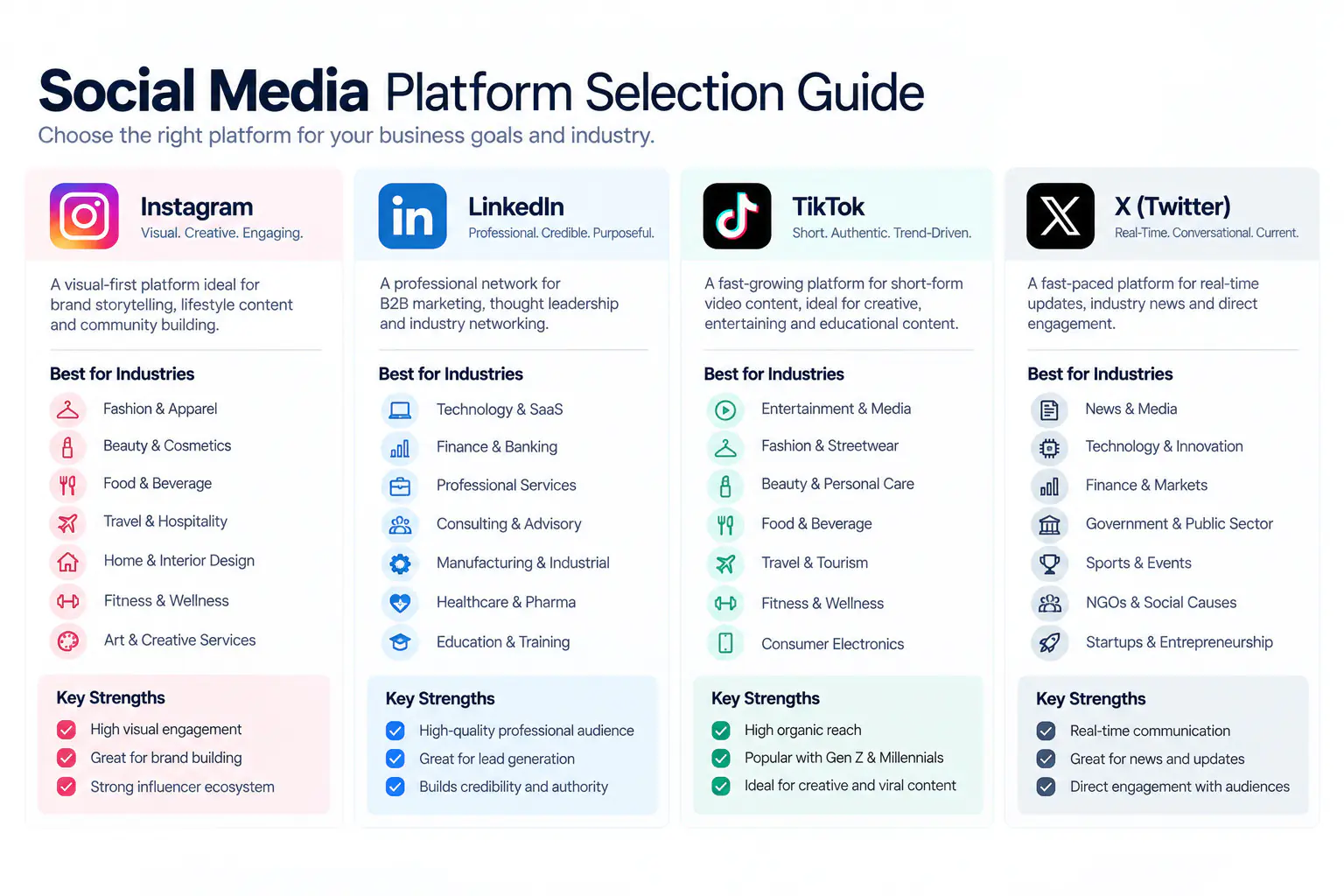
If your realistic customer base is two thousand people across the region, "reach" is an actively misleading metric. The programme is about being credible to a named list, and one platform usually carries almost all of it — see where professional audiences actually are.
The content that works is the opposite of what performs on consumer platforms: specific, unpolished, written by someone who does the work rather than by someone who writes about it. Individual employees typically outperform the company account, which is uncomfortable and worth planning for rather than resisting.
The consumer brand with a catalogue
Retail and e-commerce, where social carries both discovery and a fast content treadmill. Volume genuinely matters here, which makes production capacity the binding constraint rather than strategy — how creative gets produced at that rate and where video fits.
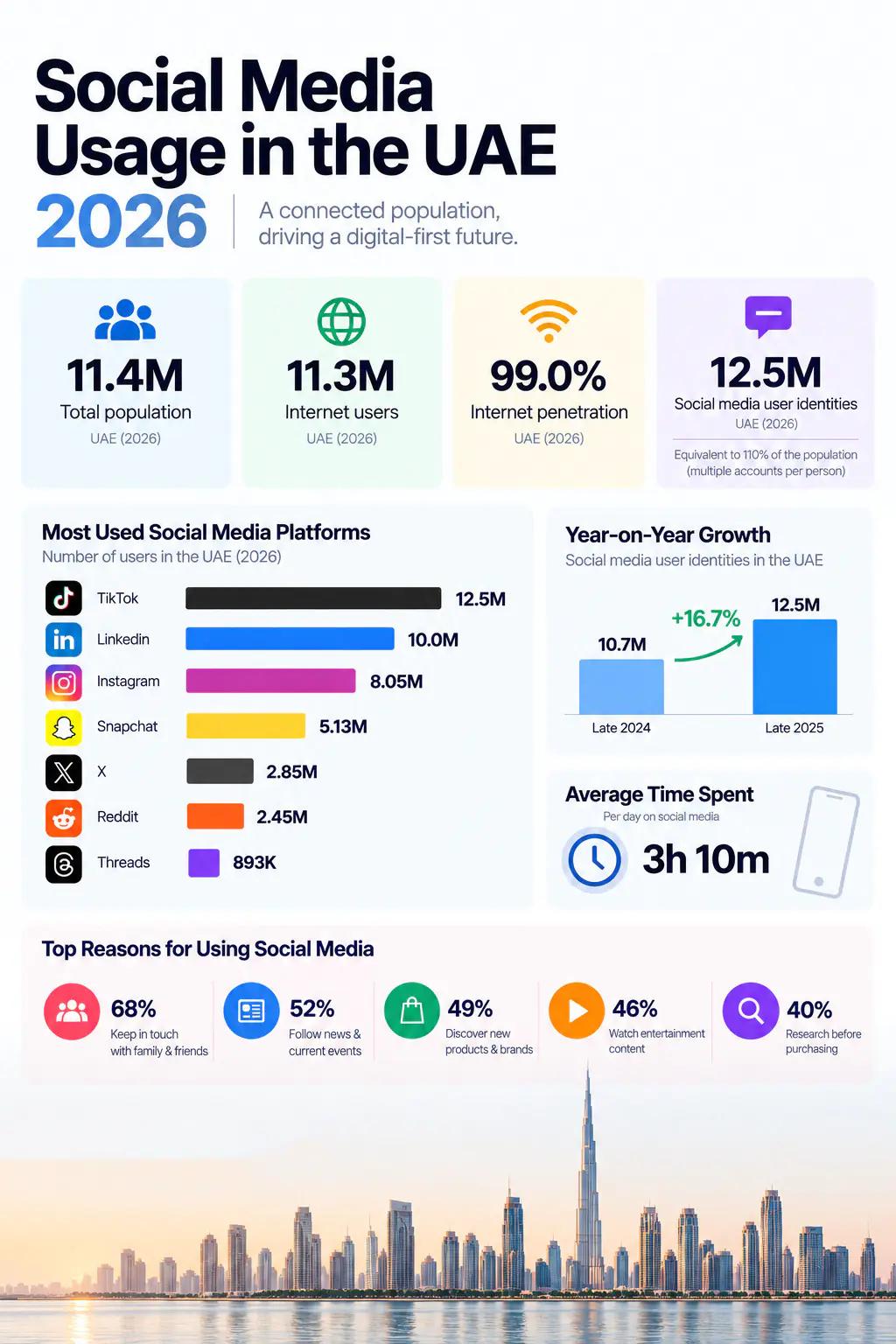
Short-form video is the format that reaches beyond your existing followers on most platforms, which puts TikTok, Instagram and YouTube at the centre of the plan, with Snapchat, which holds a stronger position in this region than it does elsewhere frequently underrated in it.
The conservative or regulated organisation
Healthcare, finance, legal, professional services, government-adjacent. Here the first question is not what to post but what may be said, by whom, and with what approval trail. A programme without a documented approval path either moves too slowly to be worth running or eventually publishes something it should not have.
The right structure is usually fewer channels, a smaller number of substantial pieces, and a written escalation route for anything unexpected in the replies.
Choosing platforms honestly
Three questions, in this order, decide the list — and the answer is nearly always shorter than the one a business arrives with.
Where is the audience, per market? Not regionally averaged. Platform usage differs materially between the six GCC countries, and a plan built on a regional average describes nowhere in particular. If you cannot state which platform matters in which market, the plan is not finished.
Which formats can you sustain for a year? A platform you cannot feed is worse than a platform you never joined, because an abandoned account is public evidence of abandonment. Sustainability is a production question, and it is the one most plans skip.
What is the platform actually for in your funnel? Discovery, consideration, service, or recruitment. Channels doing different jobs should be measured differently, and a single set of KPIs applied across all of them will misjudge most of them.
Anything left after those three questions is where you should be. Everything else is a claimed handle to stop someone else taking the name.
Connect with our specialists today — book a working session to run your current channel list through the three.
The content system, not the content calendar
A calendar says what goes out on Thursday. A system says where material comes from, so Thursday keeps arriving.
Sources, not ideas. The reliable inputs are the work itself: projects completed, questions customers actually ask, things that went wrong and what was learned, and the ordinary expertise of people who do the job. Programmes that run out of material are usually those trying to invent it rather than capture it.
Formats, decided once. A small number of repeatable formats — a customer question answered, a piece of work shown, a short explanation — produce far more output than a team inventing a new idea each week.
One production run, several outputs. A single filmed conversation becomes a long video, three short cuts, several stills and a written piece. This is where budget efficiency actually lives, and it requires planning before the camera comes out rather than after.
Both languages, written not translated. Arabic posts written in Arabic. A translated caption reads as translated, and on social the tone is most of the message.
Community, not just publishing. Replies, questions and complaints are the half of the discipline that gets no calendar entry and produces most of the goodwill. Someone has to own it, with a defined response time.
Where social output has to reflect a wider editorial plan, it belongs alongside the content strategy that feeds every channel, and it has to look like the brand in both scripts — the identity system it draws from.
The three failures that end social programmes
Programmes rarely fail loudly. They fade, and they fade in one of three recognisable ways.
Production outruns capacity. A plan built on the enthusiasm of the first month meets the reality of the fourth, output halves, and the account starts looking neglected at exactly the point the audience had begun to expect it. The fix is planning the quiet-month cadence, not the launch-month one.
Approval kills timeliness. Social rewards responding to something while it is still current. An approval chain measured in days converts every timely post into a late one, and eventually the team stops proposing them. This is solvable — pre-approved formats and a named approver with a response-time commitment — but only if it is treated as a process problem rather than a personality one.
Nobody agreed what it was for. The account was set up because competitors had one. Two years later it has followers, no stated purpose, and no way to be judged, so it survives every review by default and contributes nothing measurable. This is the most common of the three and the easiest to prevent, by writing down the funnel job before the first post.
Measuring it without fooling yourself
Social produces more numbers than any other channel and fewer useful ones.
| Metric | Worth watching when | Misleading because |
|---|---|---|
| Followers | comparing your own growth over time | it counts people who followed once and never returned |
| Reach and impressions | judging whether a format travels | platform-defined, and not comparable between platforms |
| Engagement rate | comparing formats on one platform | denominators differ; cross-platform comparison is meaningless |
| Saves and shares | assessing whether content was genuinely useful | low volume, so it needs a longer window to read |
| Profile-to-site clicks | measuring intent, not applause | undercounts in-app browsing that never leaves the platform |
| Direct messages and enquiries | it is the actual commercial outcome for most accounts | rarely tracked, because it arrives in an inbox nobody reports on |
| Branded search volume | detecting whether social is creating demand | slow, and easily confused with other activity |
The last two are the pair worth building reporting around. For most businesses the real result of social is people asking, and people later searching for the brand — neither of which appears in a platform dashboard.
The paid side is measured differently again, because it can be tested: where paid social sits against search and what each proves, and Meta campaign management specifically. Cross-channel definitions are collected in which marketing numbers actually mean something.
Our community-building framework
Audience before platforms. Who they are per market, and what they are on each platform to do. Everything downstream is a consequence of this and nothing substitutes for it.
Fewer channels, properly resourced. We routinely recommend closing accounts. Two channels done well beat five maintained.
Design the production line. Sources, formats, cadence and who produces what — agreed before the first post, because the failure mode is always month four, not month one.
Publish, then read the replies. The comments and messages are research: they tell you what your audience is confused about, faster than any survey.
Review quarterly against the funnel job. Discovery channels judged on new reach, consideration channels on returning attention, service channels on response time. One scorecard for all of them is how a working channel gets cut.
Three social accounts, written up
TheBuzihub has run social programmes in the Gulf since 2018 and publishes 24 client case studies on this site, 17 in marketing and advertising. Three are social programmes rather than campaigns: a retail brand's channels, a second retail account run in parallel, and a B2B trading company's social presence — which is the consumer-versus-B2B distinction above, visible in the same portfolio.
Where influencer partnerships form part of the plan, that has its own economics and its own risks — how those relationships are structured.
Running Social Channels — FAQ
How many platforms should we be on?
Usually fewer than you are on now. The test is whether you can sustain the format for twelve months and whether the audience for that market is genuinely there. Two well-fed channels outperform five neglected ones, and an abandoned account actively damages credibility because prospective customers read it as evidence the business has stalled.
How often should we post?
Consistency matters more than frequency, and the sustainable rate is the right rate. Platforms that reward volume — short-form video especially — need more, which makes production capacity the real constraint. Decide the cadence you can hold in a quiet month, not the one you can hold in an enthusiastic week.
Should we post in Arabic, English, or both?
It depends on the market and the audience, and the answer often differs per platform. Where both are needed, post separately in each language rather than stacking two languages in one caption. Arabic content should be written in Arabic — translated captions read as translated, and tone carries most of the meaning on social.
Do we need to be on TikTok?
Only if your audience is there and you can produce short-form video consistently. It is the strongest discovery mechanism on most platforms right now, which makes it tempting for businesses that cannot sustain it. A three-month burst followed by silence costs more credibility than never starting.
How long before social produces results?
Community and organic reach compound over six to twelve months. Paid social produces measurable response immediately but is judged over longer windows than search, because it creates demand rather than capturing it. If you need enquiries this month, paid is the honest answer and organic is the investment running alongside it.
Should our executives post personally?
On professional platforms, usually yes — individual accounts consistently reach further than company pages. It works only if the person genuinely contributes; ghost-written executive posts are recognisable and cost more credibility than they earn. A workable compromise is editorial support on material the person actually originates.
Who should respond to comments and messages?
Someone named, within a defined time, with a written escalation route for complaints and anything sensitive. Response is where most of the commercial value of an account is created and most of the reputational risk sits, and it is the part most often left to whoever happens to see the notification.
Can we just repurpose our other marketing content?
Partly. The underlying material travels well; the format rarely does, and a press release posted verbatim performs badly on every platform. Plan repurposing at production time — one filmed conversation yielding a long video, several short cuts and a written piece — rather than reformatting finished assets afterwards, which is slower and produces worse results on every channel.
Related Reading at TheBuzihub
- Professional audiences and B2B reach — where a small, named audience actually is.
- Short-form video as a discovery engine — the format that reaches beyond your followers.
- A platform stronger here than elsewhere — regional usage that regional averages hide.
- Long-form video and search on YouTube — the channel that behaves like a search engine.
- Structuring creator partnerships — disclosure, contracts and measurement.
- Producing at social's cadence — the constraint most plans hit in month four.
- Messaging as a customer channel — where conversations continue after the click.
- Two retail social accounts, published in full — the work rather than a summary.
Start by deciding what to stop
Almost every social review we run ends with a recommendation to close something.
Unlock your business potential with a free consultation: bring your current channels, whatever reporting exists, and an honest account of who produces the material. What comes back is which platforms are earning their place per market, which should be closed, and what a production system you can actually sustain would look like.
Talk to us · How we work · The full service range
Phone: +971 54 545 3510 Email:info@thebuzihub.comOffice hours: Monday to Friday 09:00–18:00, Saturday 09:00–13:00 (UAE time). Current hours are always on the contact page.