Updated for 2026
Email marketing is the practice of building a list of people who agreed to hear from you, and then sending them messages timed to what they are doing rather than to your calendar. It is the only significant channel where no algorithm decides who sees the message — which means the constraints are entirely yours: whether the address was obtained honestly, whether the message reaches an inbox, and whether it was worth opening.
Those three things decide almost everything. Design, copy and tooling matter, but they matter downstream of them.
TheBuzihub builds and runs lifecycle email programmes in English and Arabic for businesses across the UAE, Saudi Arabia, Qatar, Kuwait, Bahrain and Oman. This page is the discipline itself; the marketing service line and how an engagement is scoped is the commercial view of it.
Get a free consultation today — send us your last three campaigns and we will tell you which of the six checks below you are failing. Or call +971 54 545 3510.
The six things that decide whether email works
Everything else is execution. When a programme underperforms, the cause is nearly always one of these, and they are listed in the order they have to be fixed.
1. Permission that can be evidenced
Every address on the list should be traceable to a moment when someone asked to receive email, and you should be able to say when and where. Purchased lists, scraped addresses and "we had their card" produce the same outcome: complaints, which damage the sending reputation that every other message depends on.
This is also the point where a programme becomes legally interesting, and the rules differ across the six markets. We handle the practice — documented opt-in, a preference centre, one-click unsubscribe honoured immediately. The regulatory picture is set out separately on what consent actually requires in each GCC market, which is where that scope belongs.
2. A list that is maintained rather than accumulated
Lists decay. People change jobs, abandon addresses, and lose interest, and a list nobody prunes slowly fills with addresses that never open anything. Sending to them costs you twice: once in platform fees, and again in the engagement signals mailbox providers use to decide where your next message lands.
Maintenance means suppressing hard bounces immediately, running re-engagement on the dormant, and then actually removing the ones who do not respond. Most clients find this the hardest instruction to follow, because the list gets smaller. Revenue does not.
3. Inbox placement, which is a technical problem
An email that lands in spam had no chance to be good. Placement rests on authentication — SPF, DKIM and a DMARC policy that is published and enforced rather than set to monitor and forgotten — plus a sending domain with its own reputation, warmed gradually rather than switched on at volume.
Two operational details cause most of the damage we are called in to repair. Sending from your primary domain means a bad campaign harms your transactional mail and your staff's ordinary correspondence; a dedicated subdomain contains the blast radius. And a sudden ten-fold volume increase on a cold domain looks exactly like a compromised account, because usually it is one.
Where the sending infrastructure is entangled with the rest of the stack, that becomes an engineering conversation — see how the surrounding systems are chosen and connected.
4. A lifecycle map, not a send calendar
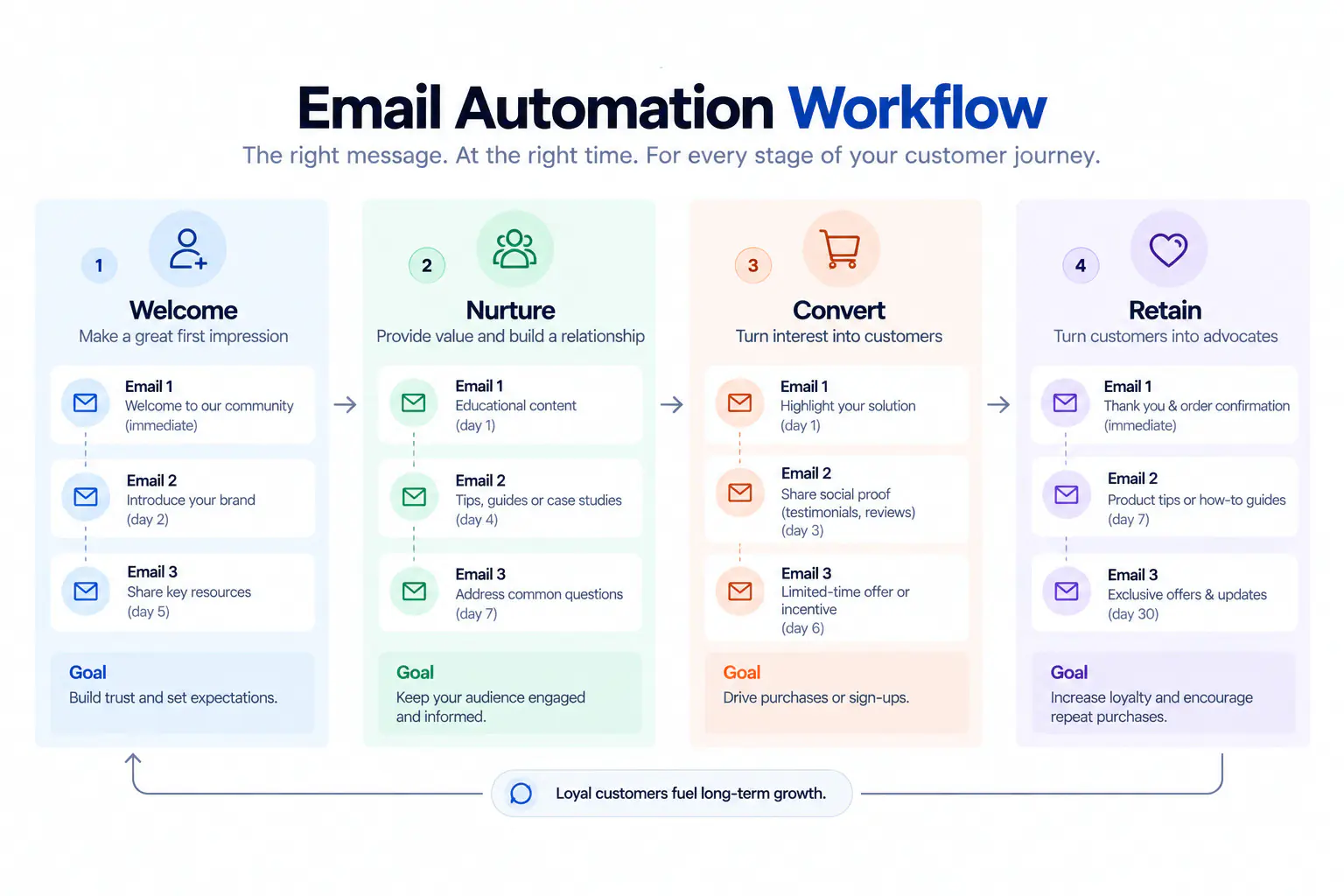
The difference between a newsletter habit and an email programme is that the programme knows why each message exists. A lifecycle map states which event triggers which message, what that message is supposed to achieve, and what happens if it does not.
Written down, it usually reveals that two or three messages are doing all the work and a dozen are decorating the calendar. It also reveals the gaps — the sequences that were never built because nobody had drawn the journey.
Automation platforms make this easy to execute once decided; they do not make the decision. Tooling comparisons live on the automation stack and what each tier is actually for and platform selection and CRM integration.
5. Relevance that comes from behaviour
Segmenting by industry and job title describes who someone is. Segmenting by what they have done — pages viewed, products browsed, previous purchases, how recently they engaged — describes what they want next, which is the useful question.
Bilingual markets add a dimension most programmes get wrong: language preference is a stated choice, not a guess from a country code. A Riyadh subscriber who signed up in English should keep receiving English. Ask once, store the answer, and honour it.
Send timing deserves the same treatment. Working hours across the GCC are officially shortened during Ramadan, and the UAE's working week differs from its neighbours', so a single regional send schedule is reaching six markets at six different points in their day. This is a calendar fact rather than a cultural assumption, and it is straightforward to build into a sending schedule once someone has noticed it.
6. Measurement that survives contact with reality
Open rate stopped being a reliable number when Apple's Mail Privacy Protection began pre-loading images regardless of whether the recipient looked at the message. It still has diagnostic uses in aggregate; it should not be the headline.
Revenue per recipient, click-to-conversion rate, list growth net of unsubscribes, and complaint rate are the numbers that hold up. Definitions for these and every other channel are collected on which marketing numbers actually mean something.
Speak with our digital experts — book a call and we will map your current sends against the six.
A lifecycle map, in one table
The shape of a working programme. The specifics change by business model; the logic does not.
| Stage | What triggers it | What it has to do | The number that judges it |
|---|---|---|---|
| Welcome | subscribing | set expectations, deliver what was promised, prove the address works | completion rate through the sequence |
| Onboarding | first purchase or signup | get them to the moment the product becomes useful | activation rate |
| Browse abandonment | viewing without acting | remove the specific hesitation, not "remind" | incremental conversion vs a holdout |
| Cart or enquiry abandonment | starting without finishing | resolve the blocker — price, delivery, trust | recovered revenue |
| Replenishment or renewal | time since last purchase | arrive before the need is met elsewhere | repeat purchase rate |
| Win-back | a defined period of silence | one honest attempt, then suppression | reactivation rate, and clean removal |
| Broadcast | editorial calendar | be worth the interruption | unsubscribe and complaint rate |
The holdout group in row three is worth insisting on. Without one, an abandonment sequence takes credit for people who were going to buy anyway, and every programme reports a return it did not earn.
The win-back row is the one clients most often want to soften. A win-back that never ends is not a win-back — it is a slow leak of complaints from people who stopped wanting your email months ago, and mailbox providers read those complaints as evidence about every message you send. One good attempt, then suppression, protects the subscribers who are still reading.
Our lifecycle-first approach
We do not start by rebuilding templates.
Read what is already happening. Twelve months of sends, revenue attribution, list growth and loss, bounce and complaint history, and the authentication records as they stand. Most programmes have one working sequence and several that quietly cost money.
Draw the journey before touching the platform. Actual customer journeys, from first contact to repeat purchase, with the moments where a message would help marked on it. The gaps become the build list, in order of value.
Fix placement first. Authentication, sending domain, list hygiene. Publishing more messages through a damaged reputation makes the damage worse.
Build the sequences that pay, in order. Usually welcome and abandonment first, because they fire on intent and their audience is already interested.
Then broadcast. Newsletters and campaigns are the last thing we build, not the first — they are the least targeted messages a programme sends and the easiest to overuse.
Hand over the reasoning. Documented segments, documented triggers, and a map your team can read. A programme only one agency understands is a liability at renewal.
Transactional email is marketing, and nobody owns it
Order confirmations, shipping notices, password resets, booking receipts and invoices are opened at rates no campaign will ever reach, because the recipient is waiting for them. In most businesses they were written once by whoever built the system and have not been looked at since.
Three things are usually worth correcting. They rarely carry the brand, so the most-read message a customer receives looks like it came from somewhere else. They almost never contain a next step, when a confirmation is the single best moment to introduce a related product or ask for a review. And they frequently share a sending domain with marketing, so a campaign that damages reputation also delays the receipts people are actively waiting for.
Fixing this is often the highest-return week of an engagement, and it involves no new sending at all.
Where email fits with everything else
Email is the collection point for other channels rather than a channel on its own. Organic and paid traffic produce visitors; something has to convert a fraction of them into addresses; email then does the patient work that neither could.
The capture side is a conversion problem — how offers and forms turn visits into enquiries and what to change on the page when arrivals are not converting. The supply side is organic search, which fills the top of it and the editorial output the newsletter distributes.
For retail and e-commerce, the highest-return sequences depend on catalogue and behavioural data the storefront has to expose — see what a storefront build needs to support. In parts of the Gulf, messaging is a stronger companion channel than it is elsewhere, which changes the mix rather than replacing it: where WhatsApp belongs alongside email.
Templates also have to look like the brand, in both scripts — the identity system and its bilingual asset set, produced by the same content and design team.
Email Programme FAQ
How often should we email our list?
Frequency matters less than consistency and relevance. A predictable monthly send outperforms an erratic weekly one, and triggered messages are not part of the frequency budget at all because the recipient caused them. Increase gradually and watch complaint and unsubscribe rates rather than picking a number in advance.
Should we send in Arabic, English, or both?
Ask at signup and store the preference. Sending both languages in one message halves the space available for each and looks like a compromise. Where the list is genuinely mixed and preference is unknown, segment by observed engagement rather than by country — an address in Riyadh is not automatically an Arabic-first reader.
Our emails go to spam. What is the first thing to check?
Authentication. Confirm SPF, DKIM and DMARC are published for the sending domain and that DMARC is not sitting permanently on none. After that, check whether you are sending from your primary domain, and whether volume increased sharply on a domain with no sending history. Those three account for most placement failures.
Is buying a list ever acceptable?
No. Beyond the legal exposure, a purchased list produces complaints from people who never asked to hear from you, and complaints damage the sending reputation that your genuine subscribers' mail depends on. One bought list can degrade delivery for a programme that took a year to build.
How big does a list need to be before this is worth doing?
Smaller than most people assume. A few hundred engaged subscribers with a working welcome and abandonment sequence routinely outperform a far larger unmaintained list receiving one monthly broadcast, because the sequences fire on intent. Size is the least predictive number on the dashboard, and chasing it usually makes the rest worse.
Do we need a marketing automation platform, or is our email tool enough?
Most businesses are limited by the journey they have not designed rather than by the tool. If sequences can be triggered on behaviour and the platform can read your purchase or CRM data, it is probably sufficient. We recommend changing platforms only when a specific, named sequence is impossible to build in the current one.
Who should our emails come from — a person or the company?
A named sender with a real reply-to address consistently outperforms a company name, and a reply address that reaches a human outperforms both. The exception is transactional mail, where recipients expect the company. Whatever you choose, keep it stable: changing the sender name resets the recognition that makes a subscriber open without thinking.
How do you prove email produced revenue rather than just being present?
With a holdout: a randomly selected slice of the audience that does not receive the sequence, compared against those who do. It costs a little revenue to run and it is the only method that separates influence from coincidence. Attribution reporting alone consistently overstates email's contribution.
Related Reading at TheBuzihub
- Consent, records and the regional rules — the legal scope this page deliberately leaves alone.
- The automation stack and what each tier is for — tooling, once the journey is decided.
- Connecting the platform to a CRM — the implementation view of the same problem.
- Turning visits into addresses — the capture work that feeds the list.
- Subscription and trial lifecycles — where onboarding sequences carry the most weight.
- The build decisions that make lifecycle data available — events, identity and the data layer underneath.
- A growth-programme engagement, written up in full — retention work in a published case study.
- An e-commerce build in the portfolio — the catalogue side these sequences read from.
Begin with the subscribers you have
Most programmes we take over do not need more sending. They need the existing list cleaned, authentication corrected, and two sequences built that were never built.
Begin your growth journey with a review of what is already running: your last twelve months of sends, your authentication records, and your list's engagement distribution. What comes back is which of the six checks you are failing and what the first fix is worth.
TheBuzihub has worked across the Gulf since 2018 and publishes 24 client case studies on this site — 17 in marketing and advertising, six in technology, and one growth programme — so the standard of work is visible before you commit to any of it.
Talk to us · How we work · The full service range
Phone: +971 54 545 3510 Email:info@thebuzihub.comOffice hours: Monday to Friday 09:00–18:00, Saturday 09:00–13:00 (UAE time). Current hours are always on the contact page.