Updated for 2026
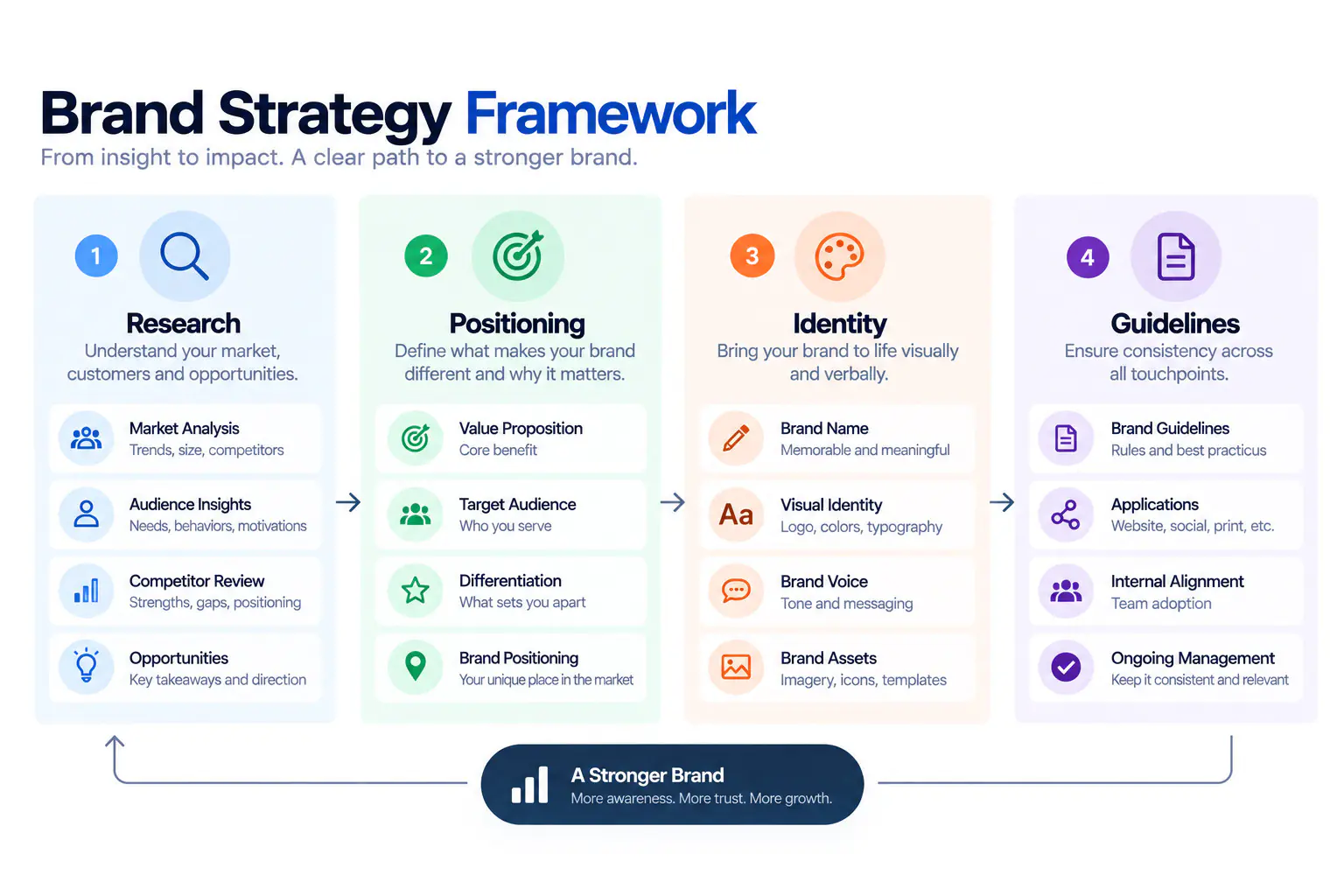
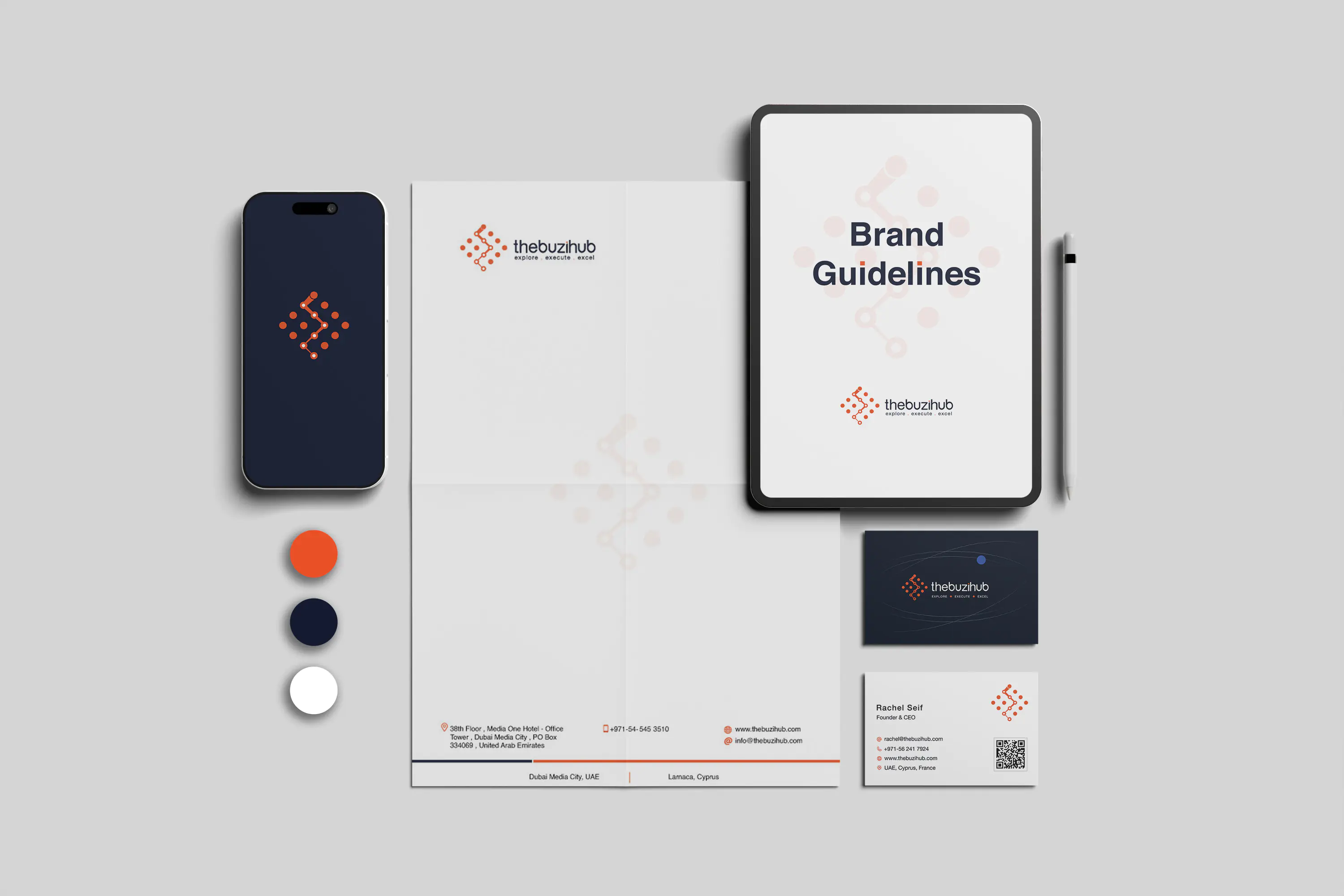
Branding is the work of deciding what a company is, and design is the work of making that decision visible everywhere the company appears. A brand identity is therefore not a logo — it is a system: marks, type, colour, imagery, tone and layout rules, plus the files and instructions that let other people apply them without asking.
In the Gulf that system has to work twice. A brand operating in English and Arabic needs both scripts designed, not one translated, and the second script is where most identities quietly fall apart.
TheBuzihub designs identity systems for businesses across the UAE, Saudi Arabia, Qatar, Kuwait, Bahrain and Oman. This page covers the discipline; the branding and graphic design service line covers how an engagement is packaged.
Speak with our creative team — send us your current assets and we will tell you whether you need a new identity or a properly built version of the one you have. Or call +971 54 545 3510.
Four situations that bring companies here
Identity work is nearly always triggered by a specific problem. Naming the situation matters, because the four below need different engagements and only one of them is a full rebrand.
A new company, before anything else exists
The fastest and cheapest identity work, because nothing has to be unpicked. The risk is the opposite one: designing for the company you are today rather than the one you intend to be in three years, and producing a mark that cannot stretch to a second product line or a second market.
We design the naming architecture at the same time as the mark for exactly this reason. Deciding now whether future products sit under the brand, beside it, or independently costs nothing; deciding it later costs a rebrand.
An identity built for print, now living on a phone
The most common situation we see. A mark drawn for signage and letterheads is asked to work as a 32-pixel favicon, an app icon, a social avatar, and a video sting, and it fails at some or all of them.
This is a rebuild rather than a rebrand: the equity in the existing mark is real and should be kept. What changes is the construction — a simplified secondary mark for small sizes, a proper colour system with contrast that passes on screen, type that has a licensed web version, and files in formats the people using them actually have.
Entering a second language
A company that has operated in English and now needs Arabic — or the reverse — is not doing a translation job. Arabic script connects, so it cannot be letter-spaced the way a Latin wordmark often is. It has no capital letters, so emphasis has to be achieved another way. Its vertical proportions differ, so a bilingual lockup that matches heights mechanically will look wrong to a reader of either script.
The correct output is an Arabic wordmark drawn as a design in its own right, optically balanced against the Latin one, plus layout rules that state what mirrors in right-to-left and what does not — numerals, phone numbers and Latin product names stay as they are.
Getting this wrong is unusually visible to the audience it is aimed at, and unusually invisible to the team that approved it.
A group whose sub-brands have drifted
Three divisions, three agencies, three interpretations, and a parent brand nobody recognises across them. The work here is architectural before it is visual: deciding what is a brand, what is a product, and what is merely a label, then designing the system that expresses the difference.
If the trigger is a name change or a merger rather than drift, that is a different project with its own sequence — what a rebrand actually involves, in order.
What an identity system contains
A deliverable list, so the scope is legible before anyone signs anything.
| Component | Why it exists | Who uses it | What breaks without it |
|---|---|---|---|
| Primary and secondary marks | one mark cannot serve signage and a favicon | everyone | someone rescales the primary until it is illegible |
| Bilingual wordmarks | Arabic drawn, not converted | regional teams | the Arabic looks like an afterthought, because it was |
| Clear-space and minimum-size rules | protects the mark in other people's layouts | printers, partners, media buyers | the logo appears crushed against a headline |
| Colour system with screen and print values | screens and presses do not share a gamut | designers, developers | brand colour drifts a shade per application |
| Type system with licensed web fonts | a typeface without a web licence cannot ship | web and marketing teams | the site substitutes a default and the brand vanishes |
| Layout and grid rules, LTR and RTL | direction changes more than alignment | anyone producing a page | mirrored layouts break numerals and product names |
| Imagery and iconography direction | keeps photography recognisably yours | content producers | a consistent brand with inconsistent pictures |
| Tone-of-voice guidance, both languages | writing is part of identity | writers, support, sales | the visual brand and the copy disagree |
| Templates for real, recurring formats | guidelines are read once; templates are used daily | everyone | the system decays within a quarter |
| Source files and a handover document | you own what you paid for | your next agency | you rent your own brand |
The last two rows are where most identity projects fail. A beautifully argued 60-page guideline that ships without templates gets read once and then ignored, and the brand drifts anyway. We weight the deliverable towards things people use on a Tuesday.
Request your personalised marketing assessment — book a review of how your identity is holding up across the places it currently appears.
Our strategic creative process
Design decisions are only defensible if they answer a question somebody asked. So the work starts with the questions.
Position before pencils. Who the company serves, what it competes against, and what it wants to be understood as — written down and agreed by the people who can approve it. Most disagreements that surface later as "I don't like the blue" are unresolved positioning arguments wearing a colour's clothes, and they are far cheaper to have in week one, in words, than in week seven with artwork on the table.
Audit what exists. Every place the current identity appears, including the ones nobody remembers: invoice templates, vehicle livery, the old exhibition stand, the app icon. This is also how the true scope of a change becomes visible before it is priced.
Territories, not options. We present a small number of distinct strategic directions with the reasoning attached, rather than a wall of variations on one idea. The choice being made is about meaning; the refinement comes after.
Design both scripts together. The Arabic and Latin marks are developed in parallel by people who read both, not sequentially by people who read one.
Build the system, then test it against reality. Applied to the hardest real formats — a small-screen header, an Arabic social post, a printed document, a vehicle — before it is signed off. Systems fail at their edges, and the edges are cheap to find early.
Hand over so it survives. Source files, licences named and transferred where transferable, templates, and a document written for the person who joins your team next year.
Where identity meets everything else
An identity that only exists in a PDF has not shipped. The system has to be implemented in the places customers actually meet the brand, and that is usually web first.
The build is where type licensing, colour tokens and RTL layout rules stop being recommendations and become code — how the front end implements a design system, and campaign pages that have to stay on-brand at speed. Commerce adds its own constraints, because product photography and packaging design are part of the identity there too — what a storefront needs from the brand system.
Then there is everything produced daily against the system: the content and creative assets that keep it fed, video and motion, where the mark has to behave in time as well as space, social output, which is where consistency is tested most often, and email templates, the format most likely to be built by someone who never saw the guidelines.
Finally, identity is what reputation attaches to. When people are describing you without you in the room, they are describing the brand — how that is monitored and answered.
What moves the cost
We do not publish prices for identity work, because the same brief costs very different amounts depending on four things — and quoting a number without them is how projects end up rescoped mid-flight. Regional budget context sits on what marketing work costs in this market.
How many brands are in scope. One brand is a project. A parent with four sub-brands is an architecture exercise plus four applications, and the architecture is the expensive half.
How many scripts and how many formats. A bilingual system is meaningfully more work than a single-script one, because the second script is designed rather than derived. Adding packaging, signage or vehicle livery each brings its own production requirements.
Whether anything is being replaced. Greenfield is cheaper than migration. Replacing an identity that already exists across a live estate means auditing every application and planning the changeover, and that inventory usually turns out larger than anyone expected.
Who implements it. A system handed to a capable in-house team costs less than one we roll out ourselves, and the difference is not small. We are happy either way; it just needs deciding before the quote rather than after.
Identity work carried through to something shipped
TheBuzihub has designed and built for Gulf businesses since 2018, and publishes 24 client case studies on this site — 17 in marketing and advertising, six in technology, one growth programme.
Two show identity work carried through into a shipped product rather than presented as a board: a jewellery brand's website and ordering system, where the visual system had to survive a catalogue, and an enterprise site where the brand had to hold across a large content structure. The wider creative work is collected in the branding and graphic design portfolio.
If you are comparing studios, the questions worth asking any agency before you hire it applies to this discipline as much as to any other — particularly the ones about file ownership.
Identity Work FAQ
How do we know whether we need a rebrand or just better assets?
If the positioning still describes the business accurately and customers recognise you, you almost certainly need a rebuild rather than a rebrand — better construction, proper files, a working system. A rebrand is warranted when the name, the market, or what the company actually does has changed, and the identity now describes a company that no longer exists.
Can our Arabic logo just be the English one translated?
No, and the difference is structural rather than stylistic. Arabic script connects and has no capital forms, so a wordmark has to be drawn rather than typed and adjusted. A mechanically converted Arabic lockup reads as unconsidered to Arabic-speaking audiences, which is precisely the audience it was added for.
Who owns the design files at the end?
You should, and it should be written into the engagement. We hand over editable source files, a handover document, and font licences where the licence permits transfer — some typeface licences are issued to a named entity and have to be purchased in your name instead, which we flag before selecting the type rather than after.
How long does an identity project take?
A focused identity for a single-brand company usually runs six to ten weeks from positioning to handover. Group architecture with multiple sub-brands takes longer, mostly in decisions rather than in design. The variable that moves the date most is how quickly the people who can approve things are available.
Do we need printed brand guidelines?
Rarely. Guidelines are worth having as a living document, but the components people actually use daily are templates and correctly built files. We deliver a concise system document plus the working assets, on the basis that a long guideline nobody opens is an expensive way to be ignored.
What if we already have a designer or an in-house team?
That is often the best arrangement. We build the system and the rules, then hand it to the people producing daily work, and stay available for the edge cases. The point of a system is that it removes the need to consult its authors for ordinary decisions.
How many logo options will we see?
Fewer than you might expect, and that is deliberate. We present a small number of genuinely distinct strategic directions rather than many variations of one idea, because a wall of options invites a decision based on preference instead of fit. Once a direction is chosen, refinement produces as many iterations as it needs.
Does a new identity affect our search rankings?
Only through what changes alongside it. A visual refresh on the same URLs is neutral. A rebrand that changes domain or URL structure needs a redirect plan, or it discards accumulated authority — the mechanics are covered in the organic side of a brand change.
Related Reading at TheBuzihub
- What a rebrand involves, in sequence — the process view, for name and positioning changes.
- Daily creative production against a system — where consistency is won or lost.
- Motion, where the mark has to behave over time — animation rules as part of identity.
- Implementing a design system in the front end — tokens, type licensing and RTL layout in code.
- Reputation, which is what identity accumulates — monitoring and response.
- The platform choices underneath a brand rollout — what a system can and cannot be applied to.
- A UAE-wide view of how the disciplines fit together — where design sits in a full programme.
- Published creative work, by category — identity and graphic design engagements in full.
Assess the assets before commissioning new ones
Almost nobody needs everything rebuilt. Most companies need three or four specific things fixed and the rest documented properly.
Start your digital transformation with an assessment: every place your identity currently appears, what is inconsistent, what is missing, and what it would take to make the system usable by the people who need it. It is a short piece of work and it usually reframes the budget conversation entirely.
Talk to us · How we work · The full service range
Phone: +971 54 545 3510 Email:info@thebuzihub.comOffice hours: Monday to Friday 09:00–18:00, Saturday 09:00–13:00 (UAE time). Current hours are always on the contact page.